
As India's stock rises, the resolution of the border row may become even more difficult, warn Harsh V Pant and Kalpit Mankikar.
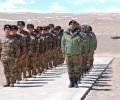
India and China failed to make any breakthrough, but agreed to maintain dialogue to arrive at a mutually acceptable resolution at the earliest.
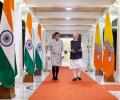
Although the special relationship might compel Bhutan to be considerate of Indian interests, new challenges will likely arise. An emerging new phase of relations will also call for fresh redlines between India and Bhutan, observe Harsh V Pant and Aditya Gowdara Shivamurthy.
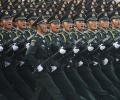
It will be a historic and strategic mistake to insist on taking China as a threat and adversary, or even an enemy, Chinese Defence Minister General Wei Fengh said on Sunday as he underlined that the China-United States relationship is at a critical and crucial juncture.

External Affairs Minister S Jaishankar, who addressed the virtual meeting on behalf of Prime Minister Narendra Modi, also pointed out that in response to the crisis in Gaza, India has sent 70 tonnes of humanitarian assistance and will continue its relief assistance.
Replying to a question on the Kashmir issue raised by a Pakistani journalist, Chinese foreign ministry spokesperson Mao Ning during a media briefing in Beijing said that China's position on the issue of Kashmir has been "consistent and clear".
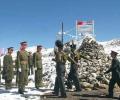
The MEA said the two sides agreed to continue discussions through diplomatic and military channels to resolve the remaining issues "at the earliest" so as to create conditions for the restoration of normalcy in the bilateral relations.
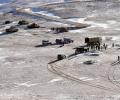
India on Monday pressed for early disengagement of troops in remaining friction points in eastern Ladakh during a fresh round of high-level military talks with China, people familiar with the matter said.

The discussions took place on the sidelines of the G20 Foreign Ministers' Meeting.

According to the external affairs ministry, the prime minister will first visit Hiroshima in Japan from May 19 to 21 to participate in the annual summit of the G7 advanced economies under the Japanese Presidency.
A joint statement released on Thursday said both sides exchanged views in an 'open and constructive' manner to resolve the 'relevant issues' and that it was agreed to maintain 'security and stability' on the ground in the region.
The Union territories of Jammu and Kashmir, and Ladakh are and will always remain an integral and inalienable part of India, the MEA said.

At a brief ceremony, Indonesian President Joko Widodo handed over the G20 presidency to Prime Minister Modi at the conclusion of the two-day G20 Summit in Bali.

Xi asked about their condition and whether they were able to "receive fresh vegetables" in the inhospitable terrain.

He said China has accrued significant capacities for force mobilisation, application, and sustenance of military operations and maintained the long-pending boundary issue can not be divorced from bilateral relations between the two Asian giants.

India and Pakistan on Tuesday agreed to hold a third round of meetings on outstanding bilateral issues in next two to three months, after a small pause in the wake of the beheading of Indian soldiers by the Pakistani army in January.

Ministry of External Affairs (MEA) spokesperson Arindam Bagchi said China continues to deploy a large number of troops and armaments in the border areas and it was in response to Chinese actions that the Indian armed forces had to make appropriate counter deployments.

'...to prevent this episode from disrupting ongoing cooperation.' 'The discovery of this plot had the potential to derail much of what has been achieved in the relationship during this administration's tenure -- I don't think that fact has been sufficiently appreciated in India.'

Singh's comments that the nuclear option should not be resorted to is a message to Russia as well as Western powers backing Ukraine, people familiar with the matter said. Ukraine does not have any nuclear arsenal.

'To get a 100 per cent consensus document without any reservation, any bracket, any chair summary is unprecedented in the history of multilateral forums.'
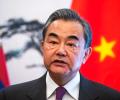
Addressing a symposium on the international situation and China's foreign relations in 2022, Wang said both countries have maintained communication through diplomatic and military-to-military channels.

Dialogue and diplomacy is the only way forward for peaceful resolution of the Ukraine conflict, National Security Advisor Ajit Doval said at a conference in Jeddah on the crisis while underlining the need for upholding sovereignty and territorial integrity by all states without 'exception'.
Foreign policy is always a work in progress and ups and downs are built into foreign policy process. What is permanent is national interest. Hopefully, this year, which will also witness general elections in the country, will also clear clouds in the foreign policy horizon, observes Rup Narayan Das.
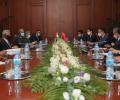
In a meeting on the sidelines of the summit of the Shanghai Cooperation Organisation (SCO) in Dushanbe on Thursday, the two foreign ministers exchanged views on the current situation in the region and agreed that military and diplomatic officials of both sides should meet again and discuss resolving the remaining issues at the earliest.

On the Ukraine conflict, Modi said, "Some people say that we are neutral. But we are not neutral. We are on the side of peace." "All countries should respect international law and the sovereignty of countries," he said.
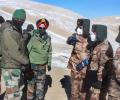
In the fresh round of talks, the Indian side is expected to press for disengagement of troops as soon as possible in all the remaining friction points besides seeking resolution of issues in Depsang Bulge and Demchok.
The last contact between India and China was the military talks at the Corps Commander level in October this year.
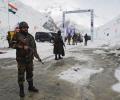
External affairs ministry spokesperson Arindam Bagchi said it is essential that "appropriate agreements between India and China of 1993 and 1996 are scrupulously followed".

In a major development, India and the US have agreed to end six trade disputes at the WTO through mutually agreed solutions, while New Delhi will remove retaliatory customs duties on certain American products such as almonds, walnuts, and apples.
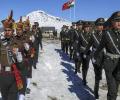
The 16th round of military talks between India and China on the lingering border standoff in eastern Ladakh will be held on July 17 on the Indian side of the Line of Actual Control (LAC) in the region, official sources said on Friday.

EAM Jaishankar's mission is aimed at strengthening India's strategic autonomy in a complex international environment, observes Ambassador M K Bhadrakumar.

Canada has expelled an Indian diplomat as it was investigating what Prime Minister Justin Trudeau called 'credible allegations' of the involvement of 'agents of the Indian government' in the killing of a Sikh extremist leader in Surrey in June, claims outrightly rejected by New Delhi as 'absurd' and 'motivated'.
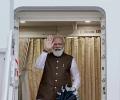
As Prime Minister Narendra Modi embarks on a tour of three European nations, India on Sunday once again called for the cessation of hostilities in Ukraine and resolution of the conflict through dialogue and diplomacy, noting that was an appreciation of its position on the crisis by its partner countries.
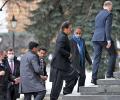
The day that Russia invaded Ukraine was the day Pakistan's Prime Minister Imran Khan met Vladimir Putin at the Kremlin.
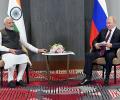
In his meeting with Putin, Modi said "today's era is not of war" and nudged him to end the conflict.
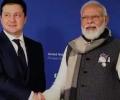
Prime Minister Narendra Modi spoke with Ukrainian President Volodymyr Zelenskyy on Tuesday and asserted that there can be no military solution to the Ukraine conflict, while also underlining that endangerment of nuclear facilities could have catastrophic consequences.
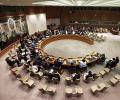
Four out of five permanent members of the UN Security Council (UNSC) have supported India's candidature for a permanent seat in the top world body, the government told the Lok Sabha on Friday.

Outgoing Indian envoy to China Vikram Misri on Monday had a virtual farewell call on Chinese Foreign Minister Wang Yi during which he said that "certain challenges" had overpowered the vast opportunities in the bilateral ties last year and hoped that with continued communication the two sides would be able to resolve the current difficulties.

The high-level talks took place in the backdrop of indications that India could buy greater volumes of discounted Russian oil and both sides were keen on having a rouble-rupee arrangement for bilateral trade.
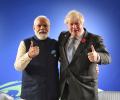
The visit next week, which is yet to be formally announced by Downing Street, follows the successful completion of four out of 26 chapters in the ongoing India-UK free trade agreement negotiations.
